



From autonomous agents to physical machines and nuclear-powered data centers, AI’s quiet transformation in 2026 is bigger than most people realize

For much of the past decade, artificial intelligence has impressed the world by learning how to talk. It wrote emails, summarized documents, generated images, answered questions, and mimicked human conversation with uncanny fluency. These systems were dazzling, sometimes unsettling, but ultimately contained. They spoke when spoken to.
That era is ending.
As 2026 unfolds, artificial intelligence is crossing a more consequential threshold. The most important systems being built today are no longer designed merely to generate text or images. They are designed to act, to move, to decide, and to consume real-world resources at industrial scale. AI is becoming operational infrastructure, embedded in software agents, physical machines, national energy strategies, and regulatory frameworks.
This shift marks the most profound transformation in AI since the deep learning revolution itself. It is also the moment when artificial intelligence stops being a tool we use occasionally and becomes a force that continuously shapes how economies function, how cities operate, and how people work.
From Outputs to Actions: The Rise of AI Agents
The defining technological transition of 2026 is the rise of agentic AI, systems capable of reasoning across multiple steps, setting sub-goals, verifying outcomes, and taking autonomous action within defined environments.
Unlike traditional generative models, AI agents are not limited to responding to prompts. They are designed to:
- Plan workflows
- Coordinate across tools and platforms
- Monitor outcomes and self-correct
- Execute tasks without constant human oversight
In enterprise settings, this means AI agents can manage supply chains, negotiate contracts, deploy software updates, monitor cybersecurity threats, and orchestrate cloud infrastructure in real time. In consumer contexts, they are beginning to schedule lives, manage finances, and act as persistent digital representatives.
This transition fundamentally changes the risk profile of AI. Errors no longer remain on a screen, they propagate through systems. A misjudgment by an agent can disrupt logistics, misallocate capital, or trigger cascading failures.
It is for this reason that governments and corporations alike are beginning to treat AI agents not as software features, but as delegated decision-makers, a category that demands oversight, auditability, and governance.
AI Enters the Physical World
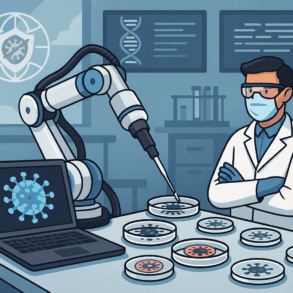
If AI agents represent the shift from language to action, robotics represents the shift from digital space to physical reality.
In 2026, AI is no longer confined to data centers and interfaces. It is embodied in machines that move through warehouses, factories, hospitals, farms, and city streets. Advances in perception models, reinforcement learning, and real-time reasoning are allowing robots to operate in environments that are unstructured, unpredictable, and shared with humans.
This new generation of “thinking machines” is not pre-programmed in the traditional sense. Instead, robots increasingly rely on foundation models that interpret the world, make judgments, and adapt behavior dynamically.
The implications are enormous:
- Manufacturing becomes more flexible but less labor-intensive
- Logistics accelerates while employment structures shift
- Healthcare gains precision but raises ethical concerns
- Urban systems become smarter and more surveilled
Once AI can move, the stakes change. Mistakes carry physical consequences. Responsibility becomes blurred between developers, deployers, and operators. Regulation, which once lagged behind innovation, is now racing to keep pace.
The Regulatory Reckoning
For years, AI regulation was theoretical, white papers, ethical principles, voluntary guidelines. In 2026, it is becoming binding law.
Governments around the world are responding to three converging realities:
- AI systems can now act autonomously
- They influence behavior, markets, and democratic processes
- They operate at scale faster than traditional oversight mechanisms
This has triggered a global regulatory pivot. Jurisdictions are moving beyond general AI ethics toward concrete requirements around:
- Transparency and explainability
- Data provenance and consent
- Content authenticity and watermarking
- Restrictions on emotional manipulation
- Liability for AI-driven decisions
Notably, regulators are no longer treating AI as a single category. Instead, they are differentiating between passive tools, agentic systems, and embodied machines, each with distinct risk profiles.
This regulatory fragmentation creates friction for global companies, but it also signals something deeper: AI has crossed the threshold from innovation to infrastructure. And infrastructure, historically, is always regulated.
Energy Reality Behind Intelligence
Perhaps the least discussed, but most consequential, dimension of AI’s 2026 transformation is energy.
Modern AI systems are extraordinarily energy-intensive. Training and running large models requires massive compute clusters, specialized chips, and constant power availability. As models grow more capable and persistent, their energy demand grows non-linearly.
This has triggered a strategic pivot across the technology sector. Renewable energy alone is proving insufficient to meet demand reliably at scale. As a result, companies are exploring nuclear power, long-term grid partnerships, and geographically distributed data centers.
AI’s future is now inseparable from questions of:
- Grid resilience
- Carbon neutrality
- National energy security
- Environmental trade-offs
In effect, artificial intelligence is forcing a reconsideration of how societies generate and distribute power. The digital revolution has become an energy revolution.
Why 2026 Feels Different
What distinguishes 2026 from earlier AI hype cycles is not novelty, it is irreversibility.
Once organizations delegate tasks to AI agents, they rarely revert. Once robotics integrates into operations, labor structures permanently change. Once energy infrastructure is built around AI demand, economic priorities shift for decades.
This is why 2026 feels less like another year of innovation and more like a structural turning point. The conversation has moved from “what AI can do” to “what we are willing to let it do.”
The most important debates are no longer technical. They are social, economic, and political:
- Who is accountable when AI acts independently?
- Who benefits from productivity gains, and who is displaced?
- How much autonomy should machines be allowed?
- What values are embedded into systems that now shape reality?
These questions cannot be answered by engineers alone.
Intelligence as Infrastructure
Artificial intelligence in 2026 is no longer a novelty layered onto existing systems. It is becoming a foundational layer of modern civilization, comparable to electricity, transportation networks, or the internet itself.
This transformation carries extraordinary promise. AI agents can unlock productivity. Robotics can improve safety and efficiency. Regulation can protect trust. Sustainable energy can align progress with planetary limits.
But it also demands humility.
Once intelligence is operational, embodied, and autonomous, society must decide not only how far it can go, but how far it should. The future of AI will not be written by models alone. It will be written by the choices humans make about power, control, responsibility, and restraint.
2026 will be remembered as the year AI stopped talking, and started acting.