




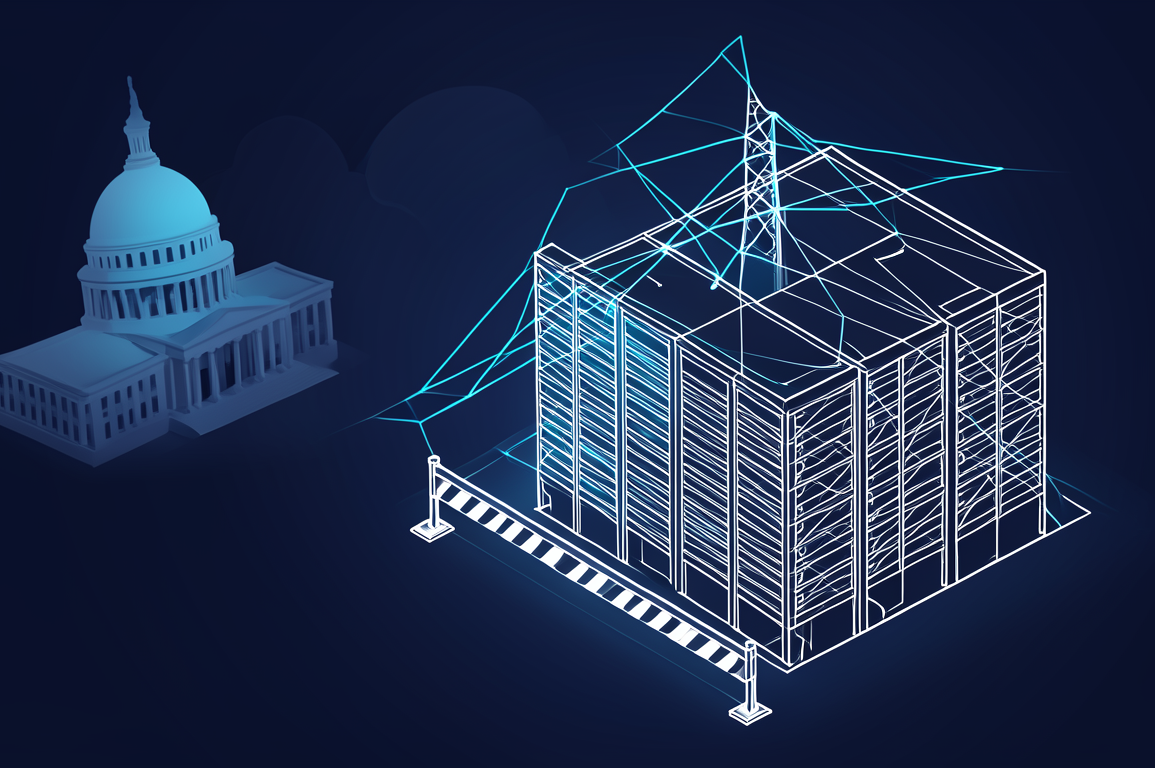

US Senator Bernie Sanders and Representative Alexandria Ocasio-Cortez have introduced legislation proposing a nationwide moratorium on new data centre construction until Congress establishes comprehensive AI regulation, according to reporting from TechCrunch AI and The Guardian published Wednesday.
The proposed bill would immediately halt permitting for data centre projects exceeding 10 megawatts of planned power consumption, affecting facilities primarily used for AI model training and inference. The moratorium would remain in effect until federal agencies implement mandatory impact assessments, energy efficiency standards, and algorithmic accountability frameworks for AI systems.
The legislative proposal arrives as US data centre construction reaches unprecedented levels, with industry analysts estimating more than $50 billion in planned investment for AI-focused facilities over the next 18 months. The timing creates immediate uncertainty for hyperscale cloud providers, semiconductor manufacturers, and enterprises planning private AI infrastructure deployments.
Sanders characterised the measure as necessary to prevent “unchecked expansion of energy-intensive AI infrastructure” whilst regulatory frameworks lag technological development. The proposal specifically targets facilities designed for large language model training, which can consume electricity equivalent to small cities during peak operation.
The business impact splits clearly along infrastructure ownership lines. Established cloud providers with existing data centre capacity—including Amazon Web Services, Microsoft Azure, and Google Cloud—would gain competitive insulation from new market entrants. Conversely, companies planning infrastructure expansion, particularly AI-native firms like Anthropic, OpenAI, and xAI, face potential delays to capacity roadmaps.
Enterprise buyers confronting extended lead times for cloud compute capacity may accelerate migration to existing providers or reconsider on-premises AI deployment strategies. The proposal could paradoxically increase prices for GPU-accelerated compute instances by constraining supply growth whilst demand continues expanding.
Utility companies and regional economic development authorities in states courting data centre investment—particularly Texas, Arizona, and Nevada—would see immediate project pipeline disruption. Construction firms specialising in hyperscale facilities face revenue uncertainty, whilst electrical equipment manufacturers may experience order deferrals.
The legislation faces substantial opposition from technology industry groups and business coalitions, who argue existing environmental permitting and grid connection processes provide adequate oversight. The Information Technology Industry Council released a statement calling the proposal “economically counterproductive” and warning of competitive disadvantage versus international AI infrastructure development.
The bill’s prospects remain uncertain given divided congressional control and the complexity of defining AI-specific facilities versus general-purpose data centres. Legal experts note potential constitutional challenges regarding federal authority over state-level construction permitting and interstate commerce implications.
Energy consumption provides the proposal’s most concrete justification. Recent data centre facilities designed for AI workloads can require 100-300 megawatts of continuous power—equivalent to serving 80,000-240,000 homes—raising grid stability concerns in multiple regions.
Market observers should monitor several developments: whether additional co-sponsors emerge from moderate Democrats or Republicans concerned about energy infrastructure; how hyperscale providers adjust capacity expansion timelines; and whether state governments pursue pre-emptive permitting approvals before potential federal intervention.
The proposal represents the most direct federal attempt to regulate AI infrastructure rather than algorithmic outputs, establishing a precedent that physical compute capacity constitutes a legitimate policy intervention point. Regardless of passage likelihood, the legislation signals growing congressional willingness to impose supply-side constraints on AI development.