








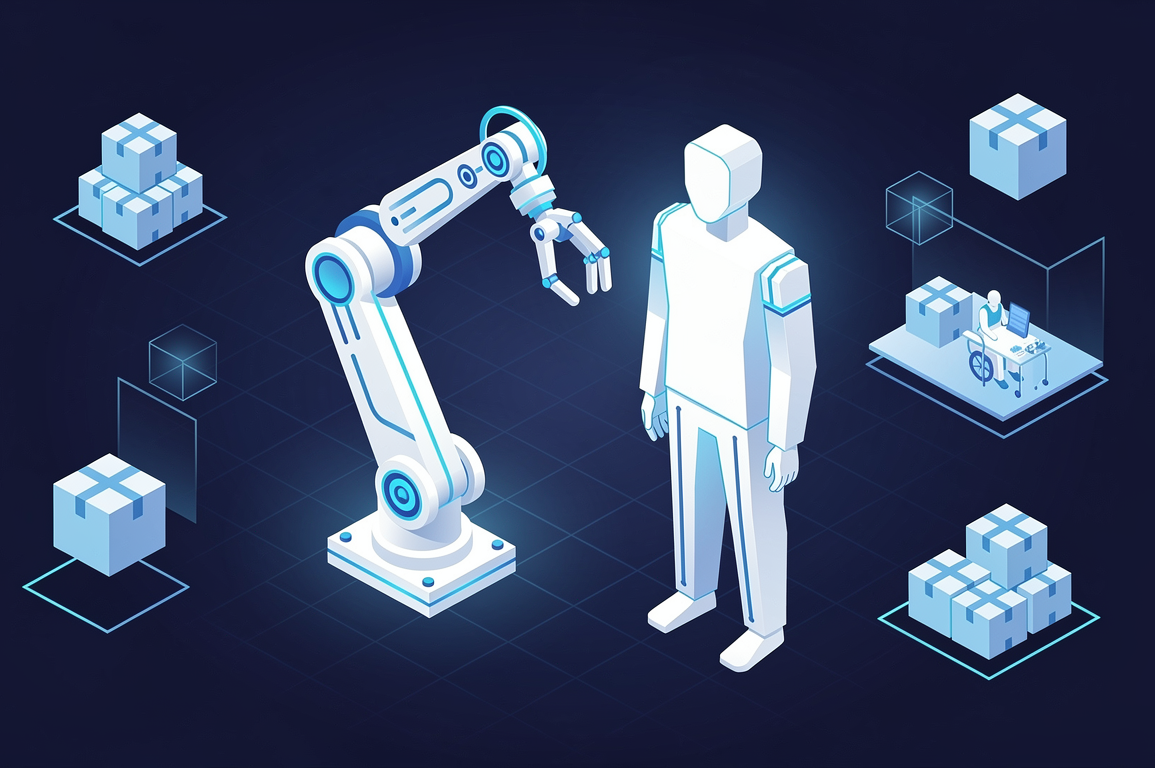

Japanese companies are deploying AI-powered physical robots across logistics centres and care facilities to address acute labour shortages, marking a significant shift from experimental trials to operational deployment in one of the world’s most rapidly aging economies.
According to TechCrunch AI, multiple Japanese firms have moved beyond pilot programmes to integrate robots capable of autonomous navigation, object manipulation, and basic human interaction into daily operations. The deployment addresses a structural problem: Japan’s working-age population has declined by more than 10 million since 1995, creating persistent vacancies that traditional recruitment cannot fill.
The robots are being deployed primarily in roles that remain chronically understaffed rather than replacing existing workers. Logistics operations are utilising autonomous mobile robots for warehouse picking and sorting, whilst elder care facilities are introducing robots capable of assisting with patient mobility and basic monitoring tasks. The distinction matters: these deployments represent AI filling genuine labour gaps rather than automating occupied positions.
This model offers a counterpoint to the prevailing narrative around AI and employment. Rather than displacement, Japan’s approach demonstrates how physical AI can address demographic constraints that threaten economic productivity. The country faces an estimated shortfall of 380,000 workers in elder care alone by 2025, according to government projections, making automation not a choice but a necessity for maintaining service levels.
Business Impact
Japanese robotics manufacturers and AI developers stand to benefit most directly, with domestic firms gaining operational experience that could prove valuable as other developed economies face similar demographic pressures. Companies deploying the technology gain immediate operational continuity in sectors where recruitment has become increasingly difficult and expensive.
The shift creates pressure on robotics firms in other markets to demonstrate similar real-world reliability. Whilst Western AI companies have focused heavily on digital applications and large language models, Japan’s emphasis on physical AI addresses tangible operational problems with measurable returns on investment.
Traditional staffing agencies and recruitment firms face limited disruption in the near term, as the robots are filling positions that would otherwise remain vacant. However, the long-term implications for labour market dynamics remain substantial if the technology scales beyond filling gaps to enabling new operational models that require fewer human workers overall.
Technical Maturity
The deployments indicate that physical AI has reached sufficient reliability for structured environments. The robots operate in controlled settings—warehouses with known layouts, care facilities with predictable routines—rather than unstructured environments. This represents a pragmatic approach to deployment: matching current technical capabilities to appropriate use cases rather than overpromising versatility.
The technology relies on advances in computer vision, manipulation planning, and navigation that have matured over the past three years. Unlike earlier industrial robots that required extensive programming for specific tasks, these systems can adapt to variations in their environment and handle objects they haven’t been explicitly trained to recognise.
Market Implications
Japan’s experience provides a testbed for other aging economies. South Korea, Germany, and Italy face similar demographic trajectories and may look to Japanese deployments as proof points for their own automation strategies. The operational data emerging from these deployments will inform investment decisions and regulatory approaches in markets where physical AI remains largely experimental.
The approach also highlights a divergence in AI development priorities. Whilst American firms have concentrated capital and talent on foundation models and digital applications, Japanese companies have maintained focus on robotics and physical systems. This specialisation may yield competitive advantages as labour shortages intensify globally.
Observers should monitor deployment scale and operational metrics over the next 18 months. The critical question is whether these robots can maintain reliability across diverse facilities and whether the economic case strengthens sufficiently to drive adoption beyond the most acute labour shortage scenarios. Japan’s demographic pressures create unique conditions, but the technology’s performance will determine whether this model transfers to markets with different labour dynamics.
The deployments demonstrate that physical AI has moved from research curiosity to operational tool in specific contexts. Whether this represents a sustainable solution to demographic decline or merely a stopgap measure depends on continued technical progress and economic viability at scale.