


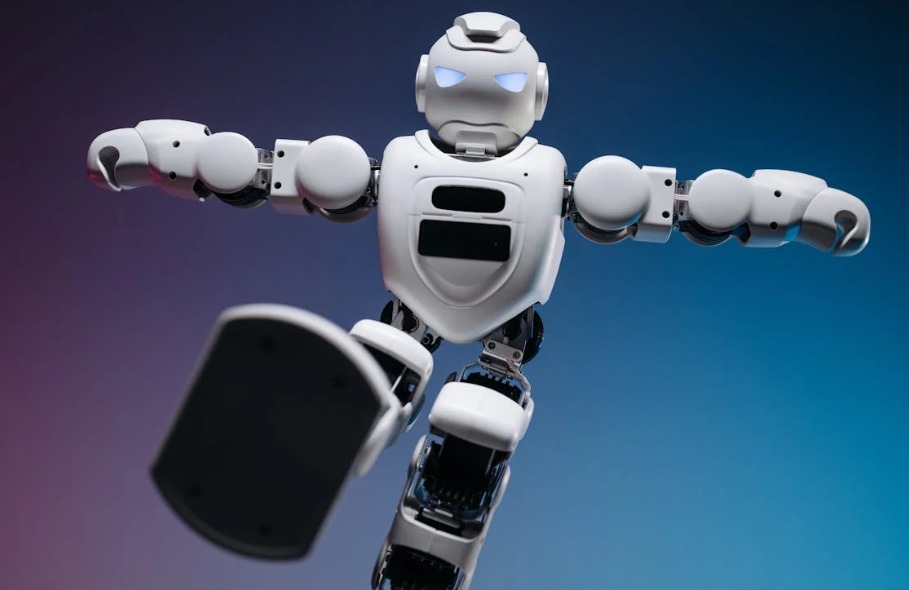
Few televised events carry as much cultural weight in China as the Spring Festival Gala. Televised annually on the eve of the Lunar New Year, it draws hundreds of millions of viewers and serves as both a celebration of tradition and a showcase for China’s evolving identity. In 2026, that identity took a striking, almost cinematic twist: humanoid robots performed complex martial arts, acrobatics and synchronized routines alongside human artists in front of a global audience. The spectacle was breathtaking, but more than entertainment , it was a vivid embodiment of China’s rapid progress in robotics and artificial intelligence, and the geopolitical and economic forces shaping that progress.
The performance marked a dramatic departure from earlier robotic appearances in the gala. Just a year earlier, humanoid units danced the traditional Yangko folk dance beside human counterparts, earning laughter and applause. In 2026, robots wielded staffs, executed aerial flips, and performed martial arts sequences with parameters once thought exclusive to trained human practitioners. Instead of simple mechanical steps, these machines displayed motion control, balance, and timing that suggested real advances in embodied AI systems.
This evolution from folk dance to kung fu is significant. It reflects not only improvements in hardware and software but also the maturation of China’s robotics ecosystem, where companies such as Unitree Robotics, MagicLab, Galbot and Noetix are now pushing boundaries far beyond novelty performances. The robots were not props; they were protagonists in a story about national ambition in technology.
Cultural Stage Becomes Technological Showcase
In China, the Spring Festival Gala is sometimes compared to the Super Bowl in terms of viewership and cultural influence. It is broadcast on national television (CCTV), reaching billions through domestic transmission and growing international streaming. Against this backdrop, the decision to feature humanoid robots in multiple segments, from comedy sketches to martial arts displays, was intentional. It signaled that robotics has moved from research labs and factory floors into the social and cultural mainstream.
Robots at the gala performed in diverse roles. Unitree’s humanoid G1 robots executed synchronized martial arts routines with children from a renowned kung fu school, combining staff combat and dynamic flips. MagicLab units engaged in precise musical choreography with pop stars. Galbot machines demonstrated dexterous everyday tasks like folding clothes and cracking walnuts with human-like grace, while Noetix robots starred in comedic sketches that explored human-robot rapport.
This was not isolated stunt engineering. It was a coordinated display of technical capabilities: balance control, rapid reorientation after dynamic maneuvers, and coordinated multi-agent motion, all supported by integrated algorithms, sensors like 3D LiDAR, and sophisticated feedback systems. The routines included world-first sequences such as continuous parkour table vaults, 7.5-rotation aerial spins, and rapid repositioning at speeds up to several meters per second.
The effect was deliberate. By merging ancient martial arts with contemporary AI, China framed its technological ambitions in terms of cultural continuity rather than cold computation. This choice resonates domestically and internationally, prompting reactions ranging from awe to strategic concern.
State of Chinese Robotics: Industry and Ambition
China’s robotics industry has been on a remarkable trajectory. According to reporting on the gala and industry figures, Chinese companies accounted for approximately 90% of global humanoid robot shipments in 2025, outpacing competitors including Tesla, which has faced delays in its own humanoid efforts. Four firms took prominent roles at the gala, Unitree, MagicLab, Galbot and Noetix, underscoring an emerging competitive cluster rather than a single corporate narrative.
This development reflects broader industrial policy. The Chinese government has identified intelligent manufacturing, embodied AI, and robotic autonomy as strategic pillars in initiatives like Made in China 2025 and subsequent five-year plans. Investments have supported R&D centers in Beijing, Shanghai and other tech hubs, promoting shared infrastructure like the “Tiangong” open-source humanoid platform and large-scale testing facilities.
It is an ecosystem that blends private and state efforts. Many robotics firms receive government subsidies or access to pilot deployment programs in industrial parks. Analysts note that China plans to transition robotics from demonstration to functionality across manufacturing, services, eldercare, logistics, and beyond. The Spring Festival Gala spotlight serves a dual purpose: public fascination and signaling to investors, partners, and global competitors.
Technology on Display: Beyond Choreography to Capability
Critics, notably in Western media, caution against overestimating staged performance as a proxy for industrial readiness. These robots perform highly orchestrated sequences on controlled surfaces, and current generation humanoids still struggle with unpredictable real-world environments. Nonetheless, the technical elements on display, dynamic gait stabilization, coordinated multi-agent interaction, and real-time sensory feedback, are not trivial. They represent progress in the underlying frameworks that drive humanoid movement and decision-making.
Those advances are not purely theatrical. Research in AI and robotics supports the same momentum. Recent work shows humanoid systems can learn dynamic whole-body skills using physics-based reinforcement learning and imitation learning from human motion video, enabling agile interactions such as sports maneuvers and coordinated tasks without bespoke reward engineering. Frameworks like HumanX leverage visual learning to instill versatile skills across domains from athleticity to object manipulation, bridging the gap between scripted routines and adaptable behaviors.
This convergence of hardware and learning algorithms is crucial. AI planners, predictive motion controllers, and high-fidelity actuator systems are gradually closing the technical gap between pre-programmed routines and robust interaction with dynamic environments. The gala performance showcased peak coordinated behavior, but the underlying systems suggest future advances may enable real-world tasks that matter economically and socially.
Robotics, Workforce and Demographic Dynamics
China faces demographic headwinds. Its population is aging more rapidly than anticipated, leading to labor shortages in manufacturing and services. Robotics has been proposed as a strategic buffer, automating repetitive tasks in factories, warehouses, and service sectors. Indeed, reports show that industrial humanoids like UBTech’s Walker S are already deployed in Shenzhen factories, working with high speed and accuracy, reducing reliance on human labor in physically demanding roles.
Projected sales forecasts, for instance, **Morgan Stanley raising China’s humanoid robot sales estimate from 18,000 to 28,000 units in 2026, signal serious commercial demand fueled by subsidies, deployment partnerships, and the expanding application stack. Robotics are not just performing on stage; they are being built for scale.
However, public perception and ethical questions persist. Scholars and analysts debate whether humanoids will spur job displacement, how humans will interact socially with intelligent machines, and whether concentration of AI and robotics power within a few nations exacerbates global inequality. China’s prominence, accelerated by a viral televised showcase, intensifies both optimism and concern about the direction of automation.
Politics, Propaganda, and Power
China’s Spring Festival Gala robots have drawn scrutiny for more than just their technical feats. Global observers note the symbolic nature of the broadcast: it presents technological progress as national identity. This is not unique to China; states have historically showcased technological achievements in cultural events. But the integration of AI and robotics into one of the most watched television spectacles captures attention differently in the age of social media, real-time video sharing, and global competition in critical technologies.
Observers in the U.S. and Europe interpret the performance as proof of concept for broader ambitions. Robotics intersects with national security, industrial competitiveness, and technological sovereignty. Anthropomorphic machines that master coordination and mobility in unstructured environments could eventually play roles in logistics, hazardous environment operations, construction, and even defense support systems.
For China, the gala is a soft power narrative: innovation rooted in culture, advancing collective capability. For international competitors, it is evidence of urgency — a reminder that technological advantage is not static, and that embodied AI will be an arena of economic and strategic priority in the coming decade.
Dancing Robots Are More Than Entertainment
China’s dancing robots at the 2026 Spring Festival Gala were more than entertainment; they were a statement. They demonstrated how quickly robotics and embodied AI have evolved, and how rapidly China is leveraging that evolution not only in labs but in public consciousness and industrial direction. The transition from dancing handkerchief routines to kung fu choreography within a year underscores the speed of progress and the role of cultural platforms in shaping global technological narratives.
Yet the road from spectacle to broad economic utility remains long. Performance stages are controlled environments. Real-world deployment requires robustness to uneven terrain, situational unpredictability, and safety constraints. But the foundational technologies, motion control, perception systems, real-time feedback loops, are maturing quickly enough that today’s gala acts may be tomorrow’s industrial collaborators.
In the contest for technological leadership, infrastructure and economics matter as much as ingenuity. China’s robots not only danced and fought; they illustrated a systemic march toward an AI-infused future in which the lines between culture and computation grow ever closer.