








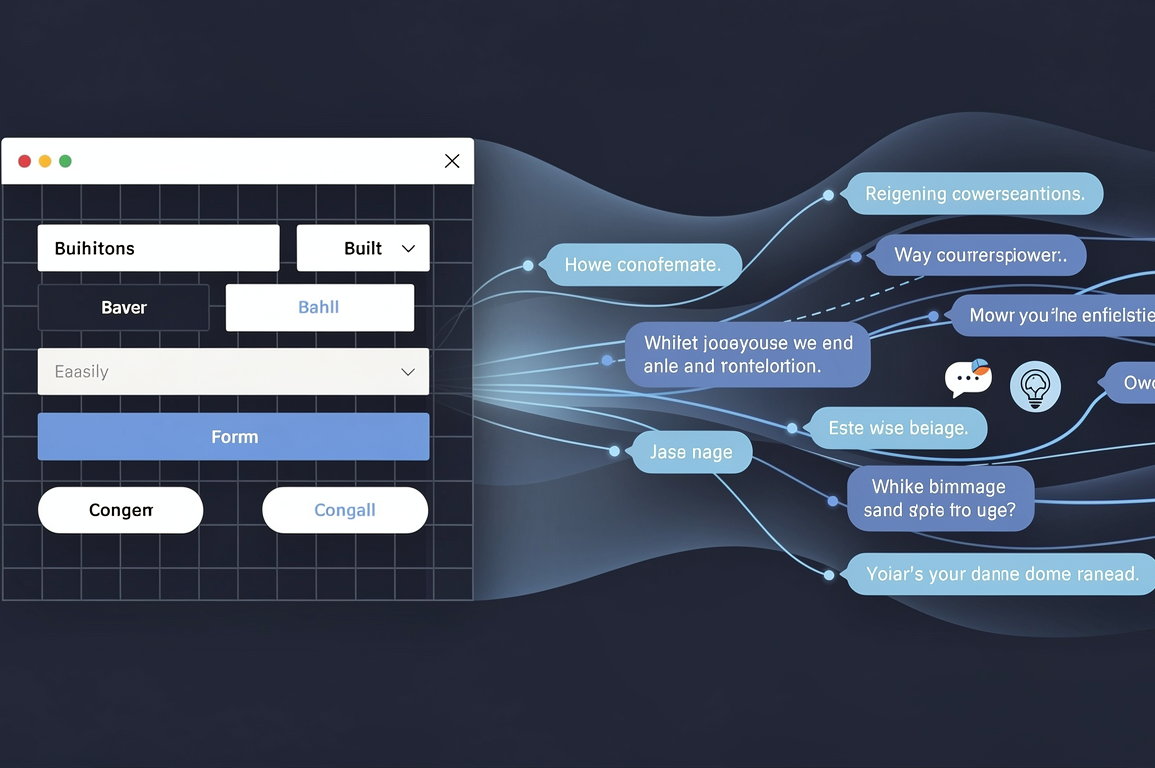

Sierra, the enterprise AI company founded by former Salesforce co-CEO Bret Taylor, has launched Ghostwriter, a platform enabling businesses to replace traditional web application interfaces with natural language agents that execute tasks across internal systems.
The platform, announced this week according to TechCrunch AI, represents a direct challenge to the click-based user interfaces that have dominated enterprise software for three decades. Rather than navigating through menus and forms, employees describe their intent in plain language whilst agents handle the underlying workflow across multiple systems.
Taylor’s thesis centres on eliminating what he terms “interface tax”—the productivity cost of learning and navigating complex enterprise applications. Sierra’s approach allows companies to build agents that integrate with existing systems including Salesforce, Workday, and ServiceNow without requiring those vendors to rebuild their products.
The business implications extend beyond user experience. Enterprise software vendors have historically captured value by controlling the interface layer, using UI complexity as a moat against competition. If natural language agents become the primary interaction model, that defensive position weakens considerably.
Sierra’s model benefits several constituencies whilst threatening others. IT departments gain the ability to modernise user experience without replacing core systems—a compelling proposition given that enterprise software replacement cycles typically span five to seven years. Employees avoid the training overhead associated with complex applications, potentially reducing onboarding costs.
Conversely, established enterprise software vendors face margin pressure. Their UI layer—often a significant portion of development investment—becomes commoditised infrastructure. The shift also threatens the business process outsourcing sector, where much work involves navigating enterprise systems on behalf of clients.
The addressable market is substantial. Gartner estimates global enterprise application software revenue at $271bn for 2024, with the user interface and experience layer representing roughly 20 per cent of development costs. That suggests a $50bn-plus market segment potentially subject to restructuring.
Sierra’s approach differs from competitors like Microsoft’s Copilot or Salesforce’s Agentforce, which embed AI capabilities within existing applications. Ghostwriter instead sits atop multiple systems, orchestrating actions across them. This architecture gives Sierra vendor neutrality but requires enterprises to grant significant system access—a potential security and compliance consideration.
The technical challenges remain non-trivial. Natural language interfaces must handle ambiguity, maintain context across multi-step workflows, and fail gracefully when user intent is unclear. Sierra’s agents reportedly use a combination of large language models and deterministic business logic to balance flexibility with reliability.
Early adoption will likely concentrate in customer service and internal IT support—domains where Sierra already has traction. The company’s existing conversational AI product serves customers including WeightWatchers and SiriusXM, providing a foundation for cross-selling the agent-building platform.
Regulatory considerations loom large. As agents gain authority to execute transactions autonomously, questions of liability and audit trails become acute. European markets, with stringent data protection requirements under GDPR, may see slower adoption than the United States.
The competitive response from incumbent vendors will prove decisive. Salesforce, Microsoft, and ServiceNow all possess the technical capability to build similar agent layers atop their own platforms. Whether they do so aggressively—potentially cannibalising their UI investments—or defensively will shape market dynamics through 2025.
Watch for enterprise pilot programmes in the coming quarters, particularly in sectors with high software training costs such as healthcare and financial services. The success rate of these deployments will indicate whether natural language agents can reliably handle the complexity of real-world enterprise workflows, or whether the button-clicking era has further to run than Taylor suggests.