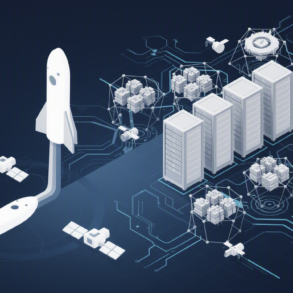




Google and SpaceX are in discussions about deploying data centres in orbit to support artificial intelligence compute workloads, according to reports from TechCrunch AI and MSN, marking what could be the most significant infrastructure development in the AI industry since the hyperscaler arms race began.
The talks between the search giant and Elon Musk’s aerospace company centre on leveraging SpaceX’s launch capabilities and satellite expertise to place computing infrastructure beyond Earth’s atmosphere, where power and cooling constraints differ fundamentally from terrestrial facilities.
The discussions come as AI companies face mounting pressure on data centre capacity. Training large language models requires massive compute clusters that strain existing infrastructure, with some estimates suggesting the industry will need to triple current capacity by 2027 to meet demand from foundation model development alone.
Space-based data centres could theoretically address several earthbound limitations. Orbital facilities would have access to continuous solar power without weather interruption, whilst the vacuum of space offers natural cooling advantages for heat-dissipating processors. However, the approach introduces formidable challenges including launch costs, radiation hardening for sensitive electronics, latency for ground communications, and maintenance complexity.
Neither Google nor SpaceX has confirmed the discussions publicly. Google declined to comment when contacted, whilst SpaceX did not respond to requests. Industry sources familiar with the matter suggest the talks remain exploratory, with no timeline established for potential deployment.
The business implications extend well beyond the two companies involved. If orbital data centres prove technically and economically viable, the development could reshape the competitive landscape for AI infrastructure. Cloud providers including Amazon Web Services and Microsoft Azure have invested tens of billions in terrestrial data centre expansion; a successful space-based alternative could render portions of that investment less competitive.
Satellite operators and launch providers stand to gain from any shift toward orbital computing. The space industry has already seen increased activity from tech companies, with Amazon’s Project Kuiper and SpaceX’s Starlink deploying thousands of satellites for communications. Adding compute infrastructure would create a new revenue stream for launch services and potentially accelerate development of in-orbit servicing capabilities.
Energy companies and terrestrial data centre operators face potential headwinds if the model scales. Data centres currently consume approximately 1-2% of global electricity, a figure projected to rise substantially as AI adoption accelerates. A viable space alternative could slow growth in ground-based facility construction.
Technical hurdles remain substantial. Radiation in orbit degrades semiconductor performance over time, requiring either expensive hardening or frequent hardware replacement. Launch costs, whilst declining, still exceed £1,000 per kilogramme to low Earth orbit. Latency for real-time applications could prove prohibitive, though batch processing for model training might tolerate the delays.
The concept is not entirely novel. In 2020, researchers at the University of Edinburgh published analysis suggesting orbital data centres could become cost-competitive by 2030 if launch costs continued declining. Several startups have explored edge computing in space, though none at the scale required for AI training workloads.
Market observers should monitor several indicators in coming months. Any patent filings related to space-based computing infrastructure from either company would signal serious intent. Announcements of partnerships with radiation-hardening specialists or thermal management firms could provide additional evidence. Changes in SpaceX’s launch manifest or Google’s capital expenditure guidance might offer indirect confirmation.
The discussions represent a fundamental question facing the AI industry: whether the infrastructure demands of increasingly large models will push computing beyond Earth’s surface, or whether efficiency improvements and alternative architectures will allow terrestrial facilities to suffice. The answer will shape technology investment for the next decade.