


SpaceX generated $2.6 billion in revenue from AI compute infrastructure deals in its most recent financial period, exceeding income from its traditional rocket launch and satellite operations for the first time, according to reports from The Verge AI and TechCrunch AI.
The crossover represents a fundamental shift in the business model of Elon Musk’s aerospace company, which has quietly built substantial GPU computing capacity alongside its Starlink satellite network. The AI infrastructure revenue now accounts for the majority of SpaceX’s total income, relegating what was once its core business—launching satellites and servicing the International Space Station—to a secondary revenue stream.
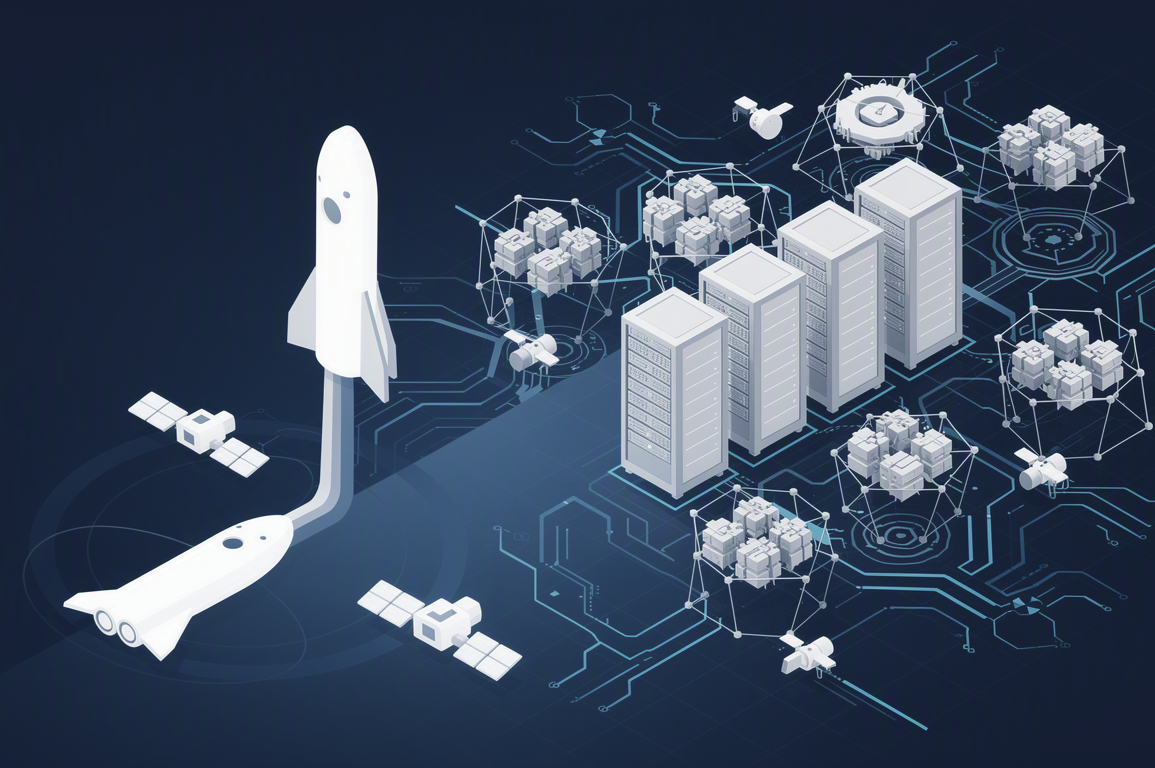
SpaceX has leveraged its existing data centre infrastructure, originally built to support Starlink’s ground operations, to offer high-performance computing services to AI developers and research institutions. The company’s unique position—controlling both satellite connectivity and ground-based compute—has allowed it to offer integrated solutions that competitors struggle to match.
The development aligns with Musk’s broader strategic repositioning across his business empire. His AI venture xAI has been a primary customer of SpaceX’s compute infrastructure, though the company has also secured contracts with external clients seeking alternatives to established cloud providers.
Market Implications and Competitive Landscape
The revenue figures position SpaceX as an unexpected major player in AI infrastructure, competing directly with Amazon Web Services, Microsoft Azure, and Google Cloud. Traditional cloud providers face a new competitor with deep pockets, vertical integration advantages, and willingness to operate on potentially thinner margins subsidised by other business units.
Established aerospace and defence contractors stand to lose as SpaceX’s attention and capital allocation shifts towards AI compute. The company’s launch cadence and new space vehicle development may slow if management prioritises data centre expansion over rocket production.
For AI developers, particularly those building large language models, SpaceX’s entry expands available compute capacity during a period of acute GPU scarcity. However, concerns about vendor concentration have emerged, given Musk’s control over multiple critical infrastructure layers and potential conflicts of interest with xAI.
The financial performance also validates the emerging “neocloud” business model, where companies build AI-specific infrastructure rather than general-purpose cloud services. CoreWeave and Lambda Labs have pursued similar strategies, but none have achieved SpaceX’s revenue scale.
Infrastructure Consolidation Accelerates
SpaceX’s pivot reflects broader consolidation in AI infrastructure, where companies controlling physical assets—data centres, power contracts, and networking—hold increasing leverage over pure software players. The capital requirements for competitive AI development have created natural monopoly conditions favouring vertically integrated operators.
The company’s Starlink network provides a potential future advantage: low-latency global connectivity for distributed AI training across multiple data centre locations. No competitor currently offers comparable satellite bandwidth at scale, though Amazon’s Project Kuiper aims to provide similar capabilities.
Regulatory scrutiny appears inevitable. Competition authorities in both the United States and European Union have begun examining vertical integration in AI infrastructure markets. SpaceX’s dominance across launch services, satellite communications, and now AI compute may trigger antitrust review, particularly given Musk’s simultaneous control of xAI.
What Comes Next
The sustainability of SpaceX’s AI revenue depends on several factors: whether external customers continue using its infrastructure or migrate to competitors, how aggressively the company prices services, and whether GPU supply constraints ease. SpaceX has not disclosed contract lengths or customer retention rates.
Investors should monitor whether SpaceX maintains its launch schedule and Starship development timeline, or whether AI infrastructure demands draw engineering resources and capital away from space operations. The company’s valuation in private markets will likely shift to reflect its new identity as an AI infrastructure provider rather than purely an aerospace manufacturer.
The financial results confirm that AI compute infrastructure has become the most lucrative segment of the technology industry, capable of generating returns that exceed even successful space businesses. SpaceX’s transformation from rocket company to cloud provider marks one of the most significant corporate pivots in recent technology history.