



Meta will begin production of its custom artificial intelligence training chips in September, according to TechCrunch AI, marking a significant step in the social media company’s effort to reduce reliance on external semiconductor suppliers whilst preparing for accelerating AI development cycles.
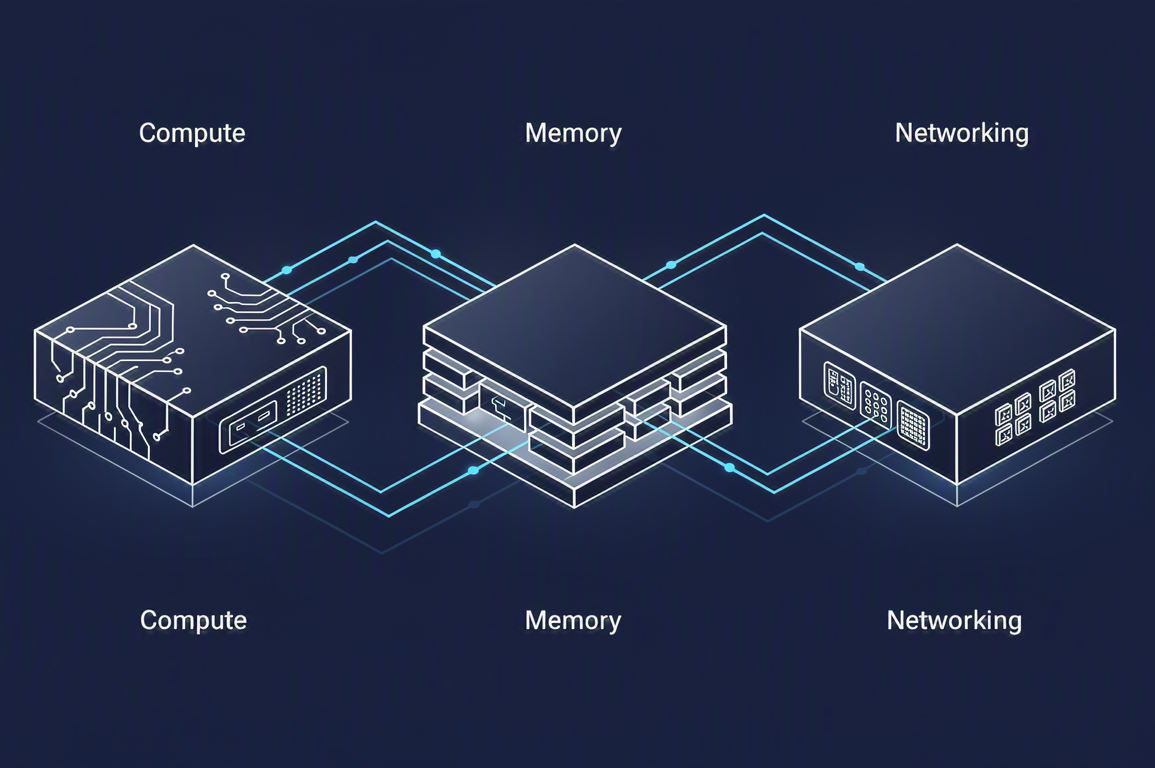
The chips employ a modular architecture that separates compute, memory, and networking components—a design philosophy that allows Meta to upgrade individual elements without replacing entire systems as AI capabilities advance. This disaggregated approach represents a departure from traditional monolithic chip designs favoured by established suppliers.
Meta has not disclosed production volumes or manufacturing partners for the September rollout. The company already operates some of the world’s largest AI infrastructure deployments, with previous disclosures indicating hundreds of thousands of graphics processing units supporting its recommendation systems, content moderation, and generative AI products including Llama language models.
Strategic Independence
The move reflects broader efforts amongst hyperscale technology companies to develop proprietary silicon tailored to specific workloads. Google has operated custom Tensor Processing Units since 2016, whilst Amazon Web Services deploys Trainium chips for machine learning training and Inferentia for inference tasks. Microsoft has announced custom AI accelerators but remains heavily dependent on Nvidia for cutting-edge capabilities.
Meta’s modular strategy addresses a critical challenge in AI infrastructure: the rapid obsolescence of hardware as models and training techniques evolve. By decoupling compute from memory and interconnect, the architecture theoretically extends useful life whilst allowing selective performance improvements. Whether this approach delivers cost advantages over integrated designs from Nvidia or AMD remains unproven at scale.
Market Implications
Nvidia currently commands approximately 80-90% of the AI accelerator market, with data centre revenue reaching $47.5 billion in its most recent fiscal quarter. Custom chip programmes from major cloud providers and AI developers represent the primary competitive threat to this dominance, though Nvidia maintains significant advantages in software ecosystems, particularly its CUDA programming platform.
For Meta, successful deployment could reduce capital expenditure on AI infrastructure whilst providing greater control over hardware roadmaps aligned to internal research priorities. The company has committed to substantial AI investments, with capital expenditure guidance for 2024 ranging between $37-40 billion, much of it directed towards infrastructure.
Semiconductor manufacturers stand to benefit differentially. Whilst reduced orders for complete GPU systems may impact Nvidia’s revenue from Meta, the modular approach likely increases demand for advanced packaging, high-bandwidth memory, and specialised interconnect technologies from suppliers including TSMC, SK Hynix, and Broadcom.
Competitors pursuing similar strategies—particularly Google and Amazon—will monitor Meta’s deployment closely for validation of disaggregated architectures. Successful implementation could accelerate industry movement away from integrated GPU designs for training workloads, though inference applications may follow different optimisation paths.
Technical Considerations
Modular chip architectures introduce complexity in system integration, thermal management, and inter-component communication. Performance depends heavily on interconnect bandwidth and latency, areas where Nvidia’s NVLink and proprietary technologies currently maintain advantages. Meta’s ability to match or exceed performance-per-watt metrics of competing solutions will determine whether the approach expands beyond internal use.
The September production timeline suggests Meta has completed validation testing and secured manufacturing capacity—non-trivial achievements given current demand for advanced semiconductor fabrication. The company has not indicated whether these chips will support only training workloads or extend to inference applications powering user-facing products.
What to Watch
Deployment scale and performance benchmarks will emerge in coming quarters, potentially through academic publications or infrastructure disclosures. Meta’s capital expenditure trajectory in subsequent earnings reports will indicate whether custom silicon delivers anticipated cost efficiencies. Broader industry adoption of modular architectures—or continued commitment to integrated designs—will signal whether Meta’s approach represents viable alternative or specialised solution for specific workloads.
The semiconductor industry’s response, particularly from Nvidia, AMD, and emerging AI chip developers, will clarify competitive dynamics as hyperscale customers increasingly develop proprietary alternatives to merchant silicon.