


Enigma Robotics has emerged from stealth with $70 million in seed funding to develop what it describes as a standardised interface layer for physical AI systems, according to reports from Unite.AI and TechCrunch AI. The round was led by Index Ventures and Ribbit Capital, marking one of the largest seed investments in robotics infrastructure this year.
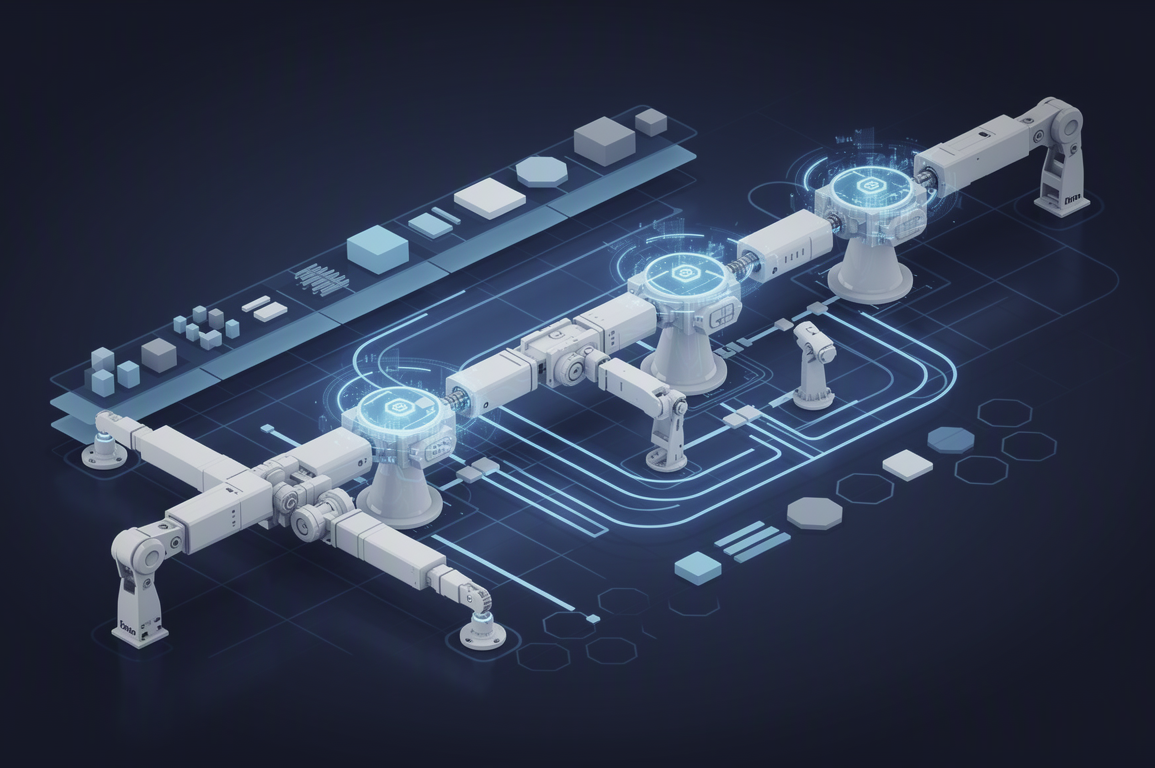
The California-based company is positioning itself not as a robotics manufacturer but as an infrastructure provider, building software and hardware interfaces that would allow AI models to control physical systems across different robot platforms. This approach mirrors the API layer that enabled the rapid proliferation of large language models, but applied to the physical world.
According to sources familiar with the company’s strategy, Enigma is developing a modular system that translates high-level AI instructions into low-level robotic commands, abstracting away the complexity of different actuators, sensors, and mechanical configurations. The goal is to enable AI developers to deploy physical capabilities without requiring deep robotics expertise.
Market Positioning
The funding reflects growing investor conviction that physical AI represents the next major infrastructure challenge after foundation models and specialised chips. While companies like OpenAI and Anthropic have focused on cognitive capabilities, and NVIDIA has dominated the computational layer, the physical interface layer has remained fragmented across proprietary robotics platforms.
Enigma’s backers include Index Ventures, which previously invested in Covariant and other robotics companies, and Ribbit Capital, better known for fintech investments but increasingly active in AI infrastructure. The unusual combination suggests investors see potential applications beyond traditional industrial robotics, possibly extending into logistics, healthcare, and consumer applications.
Business Implications
The emergence of a well-funded interface layer player creates both opportunities and competitive pressure across the robotics ecosystem. Established robotics manufacturers like ABB, Fanuc, and KUKA may face pressure to open their systems or risk being bypassed by a standardised layer that works across platforms. Conversely, these incumbents could become integration partners if Enigma’s interfaces gain adoption.
AI companies developing multimodal models with physical reasoning capabilities—including Google DeepMind, OpenAI, and Physical Intelligence—stand to gain if Enigma successfully reduces the complexity of real-world deployment. The company could accelerate the timeline for AI models to control physical systems at scale.
However, the robotics industry has historically resisted standardisation due to the diversity of physical environments and tasks. Previous attempts at universal robotics platforms, including Willow Garage’s ROS (Robot Operating System), achieved research adoption but struggled with commercial deployment at scale.
Technical Challenges
Building a truly platform-agnostic interface for physical AI faces substantial technical hurdles. Different robotic systems operate with varying degrees of freedom, force sensitivity, and real-time control requirements. A manipulation task requiring sub-millimetre precision differs fundamentally from warehouse navigation, making a one-size-fits-all interface difficult to achieve.
The company has not disclosed technical specifics about its approach, including whether it is building proprietary hardware components, focusing purely on software abstraction, or developing a hybrid system. The $70 million seed round suggests significant capital requirements, potentially indicating hardware development or extensive real-world testing infrastructure.
Competitive Landscape
Enigma enters a market with both established players and well-funded startups. Physical Intelligence raised $400 million earlier this year to develop foundation models for robotics, while Skild AI secured $300 million for similar efforts. However, these companies are primarily focused on the AI layer rather than the interface layer where Enigma is positioning itself.
The company will also compete with internal efforts by major robotics manufacturers and AI labs developing their own integration solutions. Tesla’s approach with Optimus, for instance, involves tight vertical integration rather than modular interfaces.
Outlook
The key metric to watch will be commercial partnerships announced over the next 12 to 18 months. If Enigma can secure integrations with major robotics manufacturers or deployment commitments from AI companies, it would validate the interface layer thesis. Conversely, if the company remains focused on proprietary development without ecosystem adoption, it may struggle to achieve the network effects necessary for a platform play.
The $70 million round provides substantial runway, but the capital intensity of robotics development means the company will likely need additional funding before reaching commercial scale. Whether Enigma can establish itself as essential infrastructure before competitors develop alternative solutions will determine if physical AI follows the centralised platform model that characterised cloud computing and LLM deployment.