



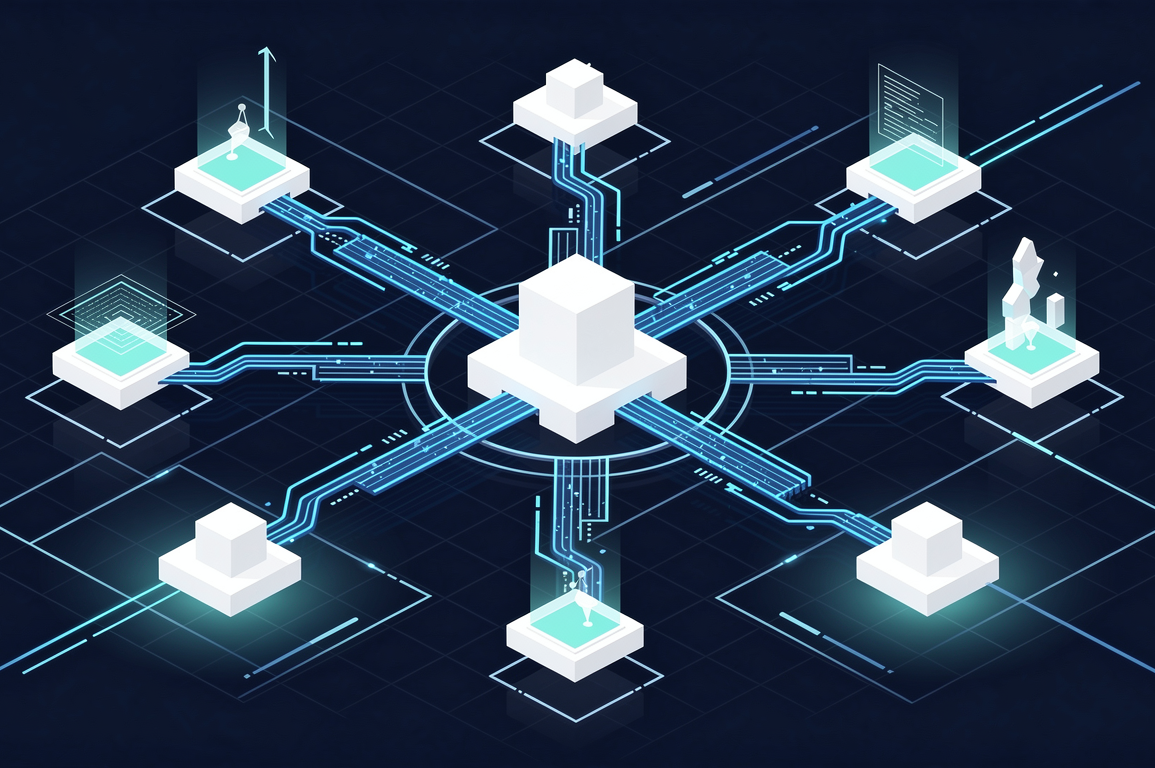

Cloudflare has launched an AI inference platform designed to let enterprises switch between large language models dynamically, addressing a critical infrastructure challenge as organisations grapple with rapidly evolving model capabilities and the risk of vendor lock-in.
The platform, announced on the company’s blog, positions Cloudflare’s global network as an orchestration layer between applications and AI models from providers including OpenAI, Anthropic, Google, and Meta. The service enables developers to route requests to different models based on performance, cost, or availability without rewriting application code.
“Companies are realising they can’t commit to a single model provider when performance rankings change quarterly,” said Matthew Prince, Cloudflare’s chief executive, according to TechCrunch AI. The platform addresses what industry observers describe as the ‘model switching problem’—the technical debt accumulated when applications are tightly coupled to specific AI providers.
Cloudflare’s entry into AI infrastructure comes as enterprises deploy increasingly sophisticated AI agents that require coordination across multiple models. The company reports processing over 1 billion AI inference requests daily across its network, providing the scale needed to offer competitive pricing and latency.
The platform includes three core capabilities: model routing based on real-time performance metrics, automatic failover when providers experience outages, and unified billing across multiple AI vendors. Cloudflare is also offering what it calls ‘Workers AI’, allowing developers to run smaller open-source models directly on Cloudflare’s edge network for latency-sensitive applications.
The business implications are significant for both enterprises and incumbent AI providers. Organisations gain negotiating leverage with model providers and reduce migration costs when switching vendors. However, the abstraction layer could commoditise AI model providers, pressuring margins for companies like OpenAI and Anthropic that currently benefit from customer lock-in through proprietary APIs.
Data Center Dynamics notes that Cloudflare’s existing relationships with enterprise customers—the company serves over 20 per cent of Fortune 1000 companies—provide immediate distribution advantages. The platform integrates with Cloudflare’s existing security and performance tools, creating switching costs for customers already embedded in the ecosystem.
The launch intensifies competition with cloud hyperscalers. Amazon Web Services, Microsoft Azure, and Google Cloud all offer similar model orchestration capabilities, but Cloudflare’s positioning as a neutral intermediary—it doesn’t develop its own frontier models—may appeal to enterprises wary of vendor conflicts of interest.
Bloomberg reported that Cloudflare is pricing the service competitively, though specific rates vary by model and usage volume. The company is betting that its global network footprint, spanning over 300 cities, provides latency advantages over centralised cloud regions.
Technical challenges remain. Model APIs aren’t standardised, requiring Cloudflare to maintain compatibility layers as providers update their offerings. The platform must also handle complex prompt engineering differences between models, which can affect output quality when switching providers mid-conversation.
Industry analysts suggest the platform’s success will depend on whether enterprises prioritise flexibility over the deeper integrations possible with single-vendor solutions. Early adopters are likely to be companies building customer-facing AI applications where uptime and cost optimisation are critical.
The market will be watching whether Cloudflare can maintain neutrality as it scales, particularly if the company faces pressure to favour certain model providers through commercial arrangements. The company’s ability to deliver on promised latency improvements compared to direct API calls will also face scrutiny as enterprises conduct performance testing.
Cloudflare’s move signals infrastructure providers see opportunity in the middleware layer between applications and AI models, betting that the current fragmented landscape of model providers will persist rather than consolidate around one or two dominant players.