


SK Group and Nvidia have announced a strategic partnership exceeding $500 billion to build AI infrastructure and expand production of high-bandwidth memory, marking one of the largest commitments to AI supply chain development disclosed to date.
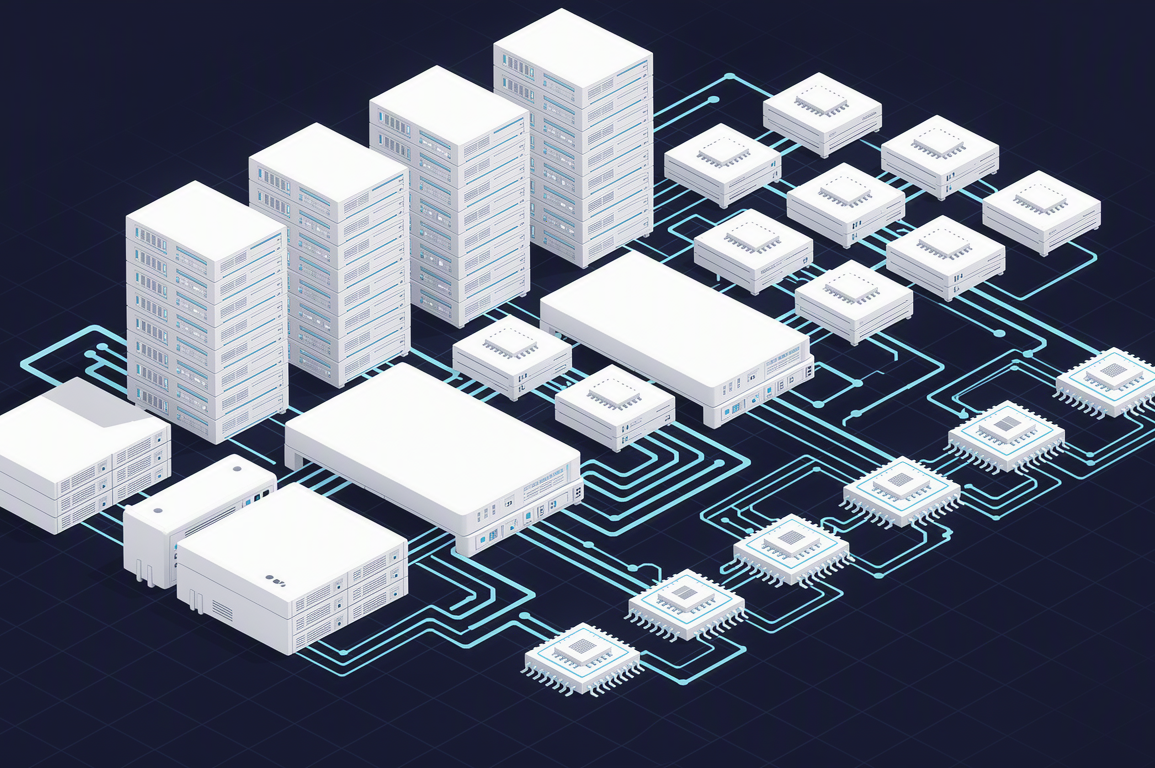
The South Korean conglomerate will deploy Nvidia’s AI platforms across what both companies term “AI factories”—large-scale data centres designed specifically for training and inference workloads. SK Group will simultaneously scale production of HBM (high-bandwidth memory) chips through its SK hynix subsidiary, which already supplies memory components for Nvidia’s flagship H100 and H200 accelerators.
The announcement addresses a critical bottleneck in AI infrastructure: the availability of advanced memory capable of feeding data to increasingly powerful processors at sufficient speeds. HBM has emerged as essential for large language models and other compute-intensive AI applications, with supply constraints limiting deployment of cutting-edge systems throughout 2023 and 2024.
“SK Group’s commitment spans our entire AI computing stack, from memory innovation to massive-scale infrastructure deployment,” said Jensen Huang, Nvidia’s chief executive, in a statement released by the company. The partnership encompasses not only hardware procurement but collaborative development of next-generation memory technologies optimised for AI workloads.
SK hynix currently holds approximately 50% of the global HBM market, according to industry analysts, positioning the company as Nvidia’s most significant memory supplier. The expanded partnership formalises a relationship that has grown increasingly strategic as AI compute demands have intensified.
The “AI factory” concept represents a shift from general-purpose cloud infrastructure towards purpose-built facilities optimised for machine learning workloads. These installations typically feature dense configurations of GPU accelerators, high-speed networking, and cooling systems designed for sustained maximum utilisation—operational profiles distinct from traditional data centres.
For SK Group, the investment represents diversification beyond its traditional telecommunications and energy businesses into AI infrastructure provision. The conglomerate operates SK Telecom, South Korea’s largest mobile carrier, and has been positioning itself to capture enterprise AI demand across Asia-Pacific markets.
The partnership carries significant implications for regional AI development. South Korea has prioritised semiconductor and AI capabilities as strategic industries, with government backing for domestic champions. This commitment provides infrastructure foundation for Korean enterprises whilst reducing dependence on US-based cloud providers for AI compute capacity.
For Nvidia, the arrangement secures critical memory supply whilst creating a major deployment partner in Asia. The company has faced scrutiny over its ability to meet accelerator demand, with memory availability frequently cited as a limiting factor. Vertical integration with a key supplier addresses this vulnerability.
The announcement also signals intensifying competition in AI infrastructure. Hyperscale cloud providers—Amazon Web Services, Microsoft Azure, and Google Cloud—have dominated AI compute provision, but telecommunications companies and conglomerates increasingly view AI infrastructure as strategic assets warranting direct investment rather than reliance on third-party platforms.
Market implications extend to Nvidia’s competitors in AI accelerators. AMD, Intel, and emerging startups have struggled to gain traction partly due to ecosystem advantages Nvidia maintains through partnerships like this one. Securing both hardware supply chains and deployment partners creates formidable barriers to entry.
The partnership timeline and specific deployment locations remain undisclosed. SK Group’s statement indicated infrastructure would support both internal AI development and commercial cloud services, though details on customer access and pricing were not provided.
Industry observers will watch whether this model—vertical integration between accelerator designers and memory manufacturers—becomes standard practice. Similar arrangements could reshape competitive dynamics if other chipmakers pursue exclusive supply relationships.
The $500 billion figure, whilst not broken down by component or timeline, represents capital commitment rather than revenue projection. It encompasses infrastructure construction, equipment procurement, and manufacturing capacity expansion across what both parties describe as a multi-year programme.
This partnership establishes a template for AI infrastructure development at national and regional scale, combining semiconductor manufacturing capacity with deployment capital to create integrated supply chains less vulnerable to the component shortages that have characterised the AI boom’s first phase.