


Google has introduced two new tensor processing units and enterprise browser automation capabilities designed specifically for deploying autonomous AI agents, marking the search giant’s most direct challenge yet to competitors’ compute infrastructure strategies.
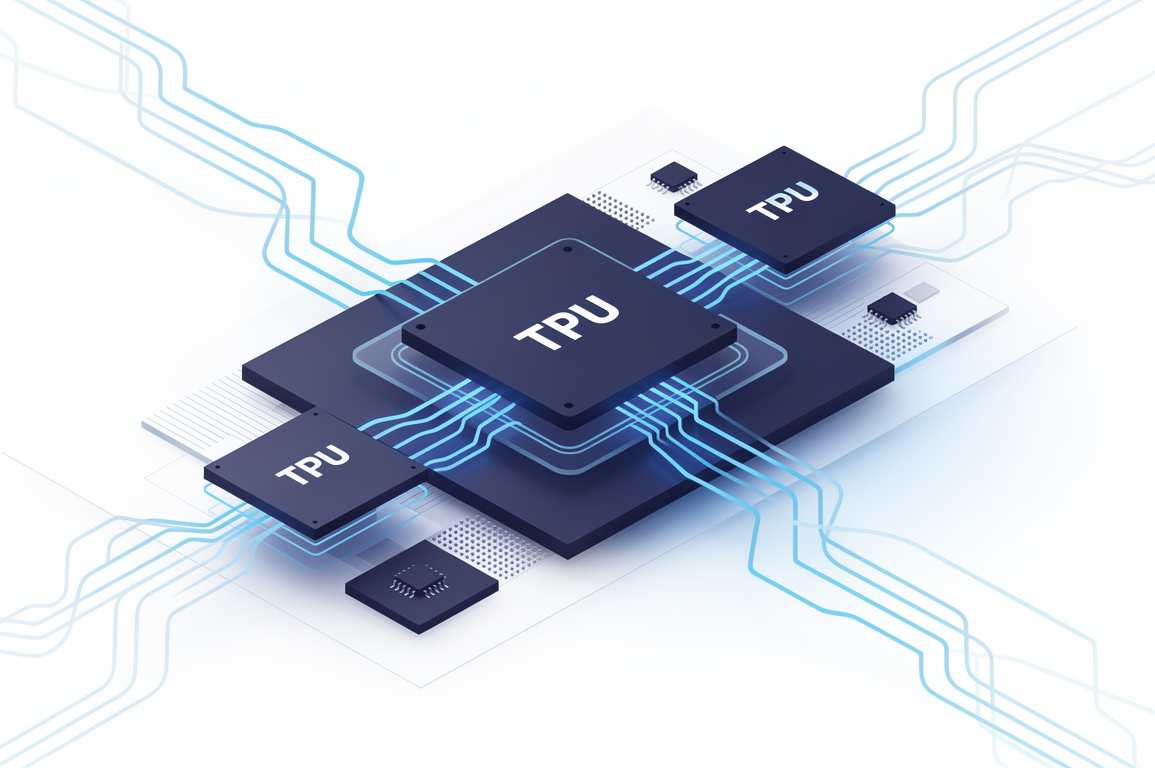
The company unveiled Trillium Ultra and Trillium Flex TPUs on Tuesday, alongside new Chrome enterprise features that allow AI agents to interact with web applications. According to Ars Technica AI, the hardware-software combination addresses the distinct computational demands of agentic AI systems, which require sustained inference capabilities rather than the burst training workloads that dominated previous generations.
Trillium Ultra represents Google’s flagship offering, delivering what the company describes as its highest performance per chip for both training and inference workloads. Trillium Flex, by contrast, prioritises cost efficiency and targets enterprises running continuous agent operations where sustained throughput matters more than peak performance.
The architectural split reflects a broader industry recognition that agentic AI—systems that autonomously pursue goals across multiple interactions—imposes fundamentally different infrastructure requirements than conventional large language model deployments. Where traditional LLM serving involves discrete query-response cycles, agents maintain state across extended sessions, make sequential decisions, and interact with external tools and data sources.
Google’s Chrome enterprise automation tools complement the hardware by providing agents with standardised interfaces to business applications. The capability allows AI systems to navigate web-based software, fill forms, and extract data without requiring custom API integrations for each application—a persistent friction point in enterprise AI deployment.
The announcement positions Google directly against Microsoft’s Azure AI infrastructure and Amazon Web Services’ Trainium chips, both of which have secured significant enterprise commitments for agentic workloads. Microsoft’s integration of autonomous agents into its Copilot platform has already demonstrated commercial traction, whilst AWS has emphasised cost efficiency for sustained inference operations.
Enterprise customers stand to gain from intensifying competition in specialised AI infrastructure. The emergence of workload-specific chip designs should drive down the total cost of ownership for running autonomous agents at scale, whilst multiple vendor options reduce lock-in risks. Companies currently evaluating agentic AI deployments—particularly in customer service, software development, and business process automation—now have additional infrastructure choices beyond Nvidia’s dominant GPU offerings.
Cloud hyperscalers face pressure to differentiate beyond raw compute capacity. Google’s integration of browser automation with custom silicon suggests infrastructure providers will increasingly bundle vertical capabilities rather than offering undifferentiated processing power. This shift favours established cloud platforms with broad service portfolios over pure-play chip designers.
The timing coincides with enterprises moving from agentic AI experimentation to production deployment. Gartner estimates that 33% of enterprise software applications will include agentic AI capabilities by 2028, up from less than 1% in 2024—a trajectory that makes infrastructure choices increasingly consequential.
Several factors will determine whether Google’s approach gains traction. Trillium’s performance and cost metrics relative to competing solutions remain undisclosed, as does pricing for the Chrome automation capabilities. Migration complexity for enterprises already standardised on alternative infrastructure presents another adoption barrier.
The broader question concerns whether specialised AI chips can maintain differentiation as model architectures evolve. Nvidia’s CUDA software ecosystem has historically insulated its GPUs from competitive pressure despite inferior cost-performance ratios for specific workloads. Google’s TPUs must demonstrate not just technical superiority but also sufficient software tooling and model compatibility to justify switching costs.
Market observers should monitor enterprise adoption patterns over the next two quarters, particularly among Google Cloud’s existing customer base. The company’s ability to convert current cloud relationships into TPU deployments will indicate whether integrated infrastructure offerings provide meaningful competitive advantage in the agentic era. Pricing announcements and independent performance benchmarks, expected within weeks, will clarify the commercial calculus for enterprises evaluating their options.