



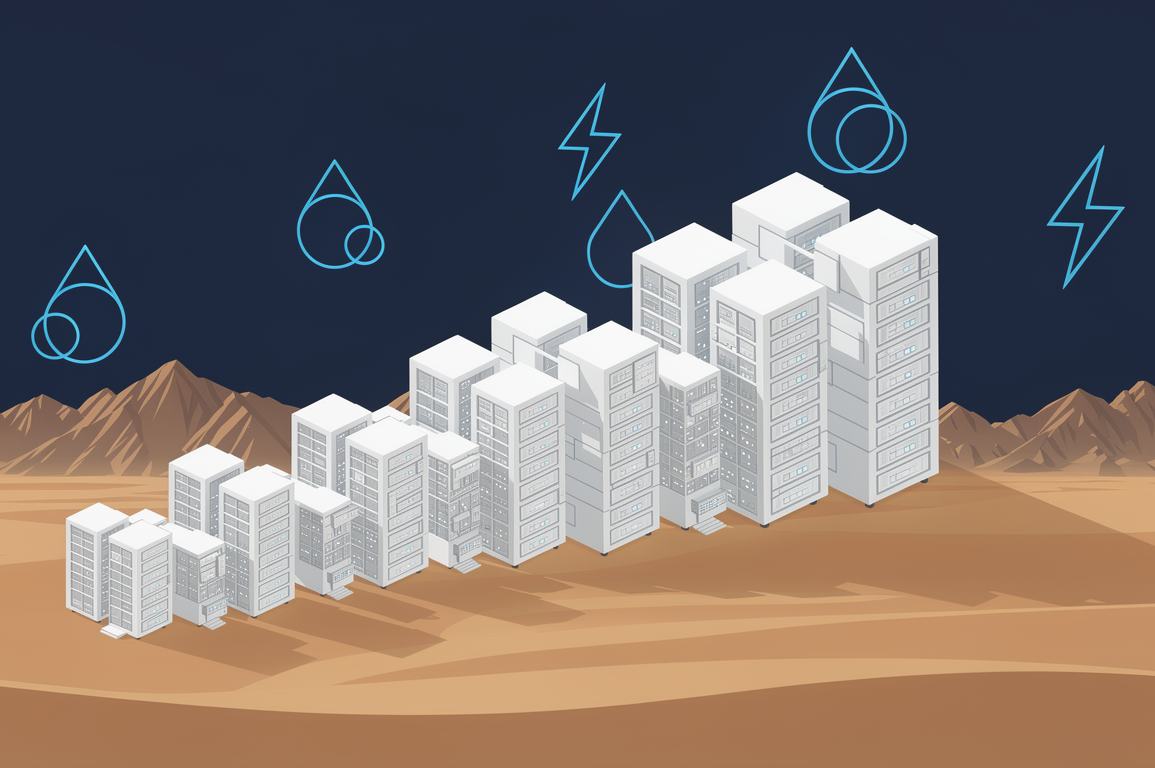

Investor Kevin O’Leary has agreed to substantially reduce the scale of a planned data centre in Utah following sustained opposition from local residents and environmental groups, according to reports from The Verge AI and TechCrunch AI. The concession marks a significant setback for AI infrastructure expansion in a region that has emerged as a key alternative to established computing hubs.
O’Leary, known for his role on the television programme Shark Tank, had proposed a massive data centre facility to capitalise on growing demand for AI compute capacity. The downsizing agreement comes after months of community resistance centred on concerns about water consumption, electricity demand, and environmental impact in Utah’s arid climate.
The retreat represents more than an isolated development dispute. It signals a broader pattern of community and regulatory resistance that threatens to constrain the physical infrastructure underpinning artificial intelligence development. Whilst hyperscalers and AI companies project exponential growth in computing requirements, the ability to site and construct the necessary facilities faces mounting obstacles.
Utah has attracted data centre investment due to its relatively low electricity costs, available land, and business-friendly regulatory environment. However, the state’s limited water resources have become a flashpoint. Data centres require substantial water for cooling systems, creating direct competition with agricultural and residential needs in drought-prone regions.
The environmental concerns extend beyond water. Large-scale data centres can strain local electricity grids, potentially requiring new generation capacity or transmission infrastructure. Communities near proposed sites increasingly question whether the economic benefits—typically modest employment numbers relative to the facilities’ physical footprint—justify the environmental costs.
Business Impact
The downsizing creates immediate challenges for O’Leary’s investment vehicle whilst potentially benefiting established data centre operators with existing permitted capacity. Companies holding grandfathered approvals or operating in jurisdictions with less stringent requirements gain competitive advantage as new entrants face higher regulatory hurdles.
Cloud infrastructure providers including Amazon Web Services, Microsoft Azure, and Google Cloud may find their existing data centre portfolios increasingly valuable as new capacity becomes harder to permit. AI companies reliant on third-party compute—particularly well-funded startups planning significant training runs—face potential capacity constraints that could delay product development.
The broader market implication centres on compute costs. If regulatory and community opposition systematically limits new data centre construction, the constrained supply could drive prices upward, potentially slowing AI development or concentrating it amongst better-capitalised players with secured infrastructure access.
Regulatory Trajectory
The Utah case follows similar conflicts in other jurisdictions. Ireland has imposed restrictions on new data centre connections to Dublin’s electricity grid. Singapore instituted a moratorium on new facilities. The Netherlands has limited data centre development in the Amsterdam region. These precedents suggest a coordinating trend rather than isolated incidents.
Environmental impact assessments for data centres are becoming more rigorous, with particular scrutiny on water usage and carbon emissions. Operators increasingly face requirements to demonstrate renewable energy sourcing and water recycling systems, adding costs and complexity to new projects.
The political economy of data centres is shifting. Early projects benefited from local enthusiasm for technology investment and economic development. As communities gain experience with the actual impact—including noise from cooling systems, visual blight, and resource consumption—opposition has organised more effectively.
Strategic Implications
For AI companies, the infrastructure constraint introduces a new variable into scaling calculations. Technical breakthroughs in model efficiency or algorithmic improvements may prove easier to achieve than securing physical computing capacity in acceptable locations.
The situation may accelerate interest in alternative approaches including edge computing, more efficient chip designs, and algorithmic techniques that reduce computational requirements. Companies with in-house data centre expertise and established facilities gain strategic advantage over those dependent on rapidly expanding third-party capacity.
Investors should monitor permitting timelines and community opposition as leading indicators of infrastructure availability. The gap between announced data centre projects and those that achieve operational status appears to be widening, suggesting that paper capacity projections may overstate actual supply growth.
O’Leary’s concession in Utah demonstrates that AI infrastructure expansion faces tangible physical and political constraints that may prove as significant as technical or financial limitations in shaping the industry’s development trajectory.